
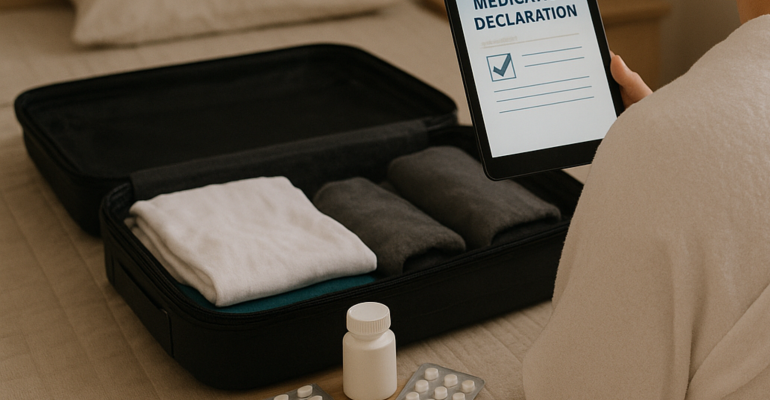
New Rules on Bringing Controlled Medication to Saudi Arabia
What’s new (as of 1 November 2025)
-
Saudi Food and Drug Authority (SFDA) now requires all travellers including pilgrims who wish to bring controlled medications (i.e. medications containing narcotic or psychotropic substances) into or out of Saudi Arabia to obtain a clearance permit in advance.
-
Medications that fall under this regulation include certain painkillers, sleeping pills, anxiolytics, stimulants, antidepressants or any medications containing narcotic or psychotropic substances.
-
Bringing such medications without a valid permit is prohibited.
Who is affected
- Pilgrims travelling to perform Hajj or Umrah, arriving by air, land or sea.
- Travellers carrying controlled medication for themselves or for another person (e.g. a family member). The new system allows you to declare medicines on behalf of someone else.
What you need to do: Step-by-Step Guide
Check if your medicine is controlled
- If your medication is a narcotic, psychotropic, or contains controlled substances (e.g. certain painkillers, sleeping pills, stimulants, anti-anxiety drugs, etc.), it must be declared.
- If in doubt, especially for less common or strong medications treat it as controlled and apply.
Apply for a clearance permit via the Controlled Drug System (CDS)
- Access the official CDS Registration portal: cds.sfda.gov.sa
- Create a personal traveler account (if you don’t already have one).
- Submit a “clearance request” specifying whether the medications are for yourself or someone else.
Provide required information and upload documents
- Personal/traveller details (name, passport/ID, nationality, etc.)
- Travel details (arrival/departure dates, flight or port information)
- For each medication: trade name, active ingredient, strength/concentration, form (tablet, injection, etc.), pack size or quantity.
- Supporting documents: a valid medical prescription and/or a medical report, plus proof of identity (passport copy)
Submit and track your application
- Once submitted, your application status will show as “Submitted,” “Completed,” “Rejected,” or “Incomplete.”
- If approved, you must print the permit and carry it with your medication when travelling.
Bring only the amount needed for your stay
- Only quantities matching the duration of your visit (or up to a one-month supply) are allowed.
- If you run out of medication while in Saudi Arabia, you must visit a licensed medical facility, register a medical file there, and get a new prescription from a Saudi-licensed doctor.
If medication belongs to another person (e.g. you carry for a family member)
- You must include the patient’s name, relationship, ID/passport info, and if not a direct relative, a written consent authorizing you to carry the medication.
SFDA Account & Medication Registration Guide
Why this procedure matters
-
Controlled medications especially those containing narcotics or psychotropic substances are strictly regulated under international and national drug laws. The new process helps prevent drug misuse, while ensuring legitimate patients are able to travel safely with their necessary medicines.
-
The new online permit system (CDS) is designed to streamline the process, avoid last-minute complications at airports or border points and give travellers clarity and transparency.
What every pilgrim should do BEFORE travel
-
Review your current medications and check if any are narcotic, psychotropic or otherwise controlled under Saudi regulations.
-
Gather a valid prescription or medical report (issued in the last 6 months if possible), passport/ID copy and details of medications.
-
Register and submit a permit application via the SFDA CDS portal well ahead ideally several weeks before departure, to allow time for processing.
-
Once approved, print the permit and carry it along with the medication in your carry-on luggage (in original packaging).
-
If bringing medication for another person (family member), ensure you include all required info and consent documentation.
How this affects Hajj & Umrah pilgrims (Why this matters for you)
As an organisation involved in Hajj/Umrah logistics and support, we understand many pilgrims travel with ongoing medical needs, whether chronic conditions, pain management, sleeping aids or other prescriptions. With this new regulation in force:
-
Applying for clearance becomes a mandatory step for any pilgrim travelling with controlled medications.
-
Failure to hold a valid permit may result in confiscation of medication or denial of entry, which could severely impact a pilgrim’s health and ability to complete the pilgrimage.
-
Having the permit in advance ensures a smoother journey, avoids delays at customs, and provides peace of mind.